
Learn how hardware and building supply retailers can connect systems, reduce manual admin and automate order management with one tailored operating platform the.
Hardware and building supply retailers trade accounts automation software review: What Breaks Daily
Hardware and building supply retailers trade accounts automation software review should connect bookings, people, communications and reporting in one reliable operating flow.
Hardware and building-supply retailers manage complex trade accounts and logistics daily. Branch stock levels fluctuate, special orders demand attention, and customer service handles returns and queries. These tasks often rely on disjointed systems or manual processes. As a result, orders can be delayed, stock data errors creep in, and trade account reconciliations become tangled. For businesses operating under tight margins and customer expectations, these daily breakdowns create significant operational drag.
Trade accounts in particular present challenges: credit limits, pricing tiers, payment terms, and return policies vary widely by customer. Without integrated workflows, staff spend hours cross-checking data, updating spreadsheets, and chasing exceptions. Those manual steps increase errors and slow response times, directly impacting revenue and customer loyalty.
The solution lies in connected workflows that automate routine tasks, bring critical data into one reliable record, and empower decision-making via focused AI capabilities—while preserving human control over sensitive approvals.

The High Costs of Manual Processes and Disconnected Systems
Manual intervention in order management and inventory control causes delays, errors, and compliance risk. Staff time wasted on duplicated data entry is a hidden cost. Pricing or payment data mistakes can lead to disputes, breaches of consumer rights or payment regulations, and damaged reputation.
Financially, poor cashflow insight follows from delayed invoice processing and weak integration between sales and accounting. Without a reliable single system of record, branches cannot coordinate stock replenishment efficiently, leading to overstock or stockouts.
As hardware store inventory software and automation tools multiply in the market, the real challenge is avoiding fragmented solutions that multiply IT complexity and subscription costs. Instead, retailers benefit from owning one tailored, connected operating system centred on how their business works today—and scales tomorrow.

Centralised Trade Accounts Management Tailored to Your Credit Rules
Tackling fragmented credit controls and trade pricing sheets
Trade accounts come with multiple credit limits, payment terms, and discount structures. Disconnected spreadsheets or legacy systems mean staff double-check terms manually before order approval, risking errors or unauthorized credit extensions.
How connected workflows enforce credit rules reliably
A single trade accounts module creates the credit rules you set and enforces them in real time. Credit limits, payment terms, and pricing tiers link directly to customer records and sales workflows. Any exception—such as orders exceeding credit limits—routes automatically for review.
Practical integration with existing invoicing and accounting
Your accounting software stays connected. Trade account data flows seamlessly into invoicing and ageing reports, maintaining audit trails and compliance. For retail finance control, system alerts highlight overdue accounts for immediate action.
Example: Automated credit check before order confirmation
When a trade customer places a special order via branch staff, the system checks financial status instantly. If their account is within terms, order proceeds automatically. Otherwise, the order pauses with notifications sent to credit controllers for prompt handling.
Controls to keep regulatory oversight
Configured rules maintain compliance with the Consumer Rights Act and FCA guidelines where applicable, ensuring approval points for credit adjustments remain visible and auditable.

Real-Time Branch Stock Visibility and Replenishment Automation
The challenge of synchronising stock levels across stores
Branches stock different core items but may need to source from each other for special orders. Manual stock reports are often inaccurate or out of date, causing lost sales or redundant inventory.
Creating a single source of stock truth
A connected stock system synchronises real-time levels across branches, reflecting reservations, incoming deliveries, and returns immediately in a unified workspace.
Automating replenishment based on reliable thresholds
Configured inventory alerts notify the procurement team when stock levels drop below agreed minimums. Automated purchase orders can be generated and routed for approval, based on sales velocity and seasonal trends.
Concrete example: Automated inter-branch transfers
If one branch is out of a particular timber size, the system automatically highlights a nearby branch with available stock and prompts a transfer request. Warehouse staff receive notifications to prepare the transfer shipment.
Control measures for stock accuracy
Stock adjustments require authorised validation with audit logs to track discrepancies or physical audits, supporting compliance with inventory control best practices.

Special Order Processing with Exception Routing and Status Tracking
Managing the complexity of non-stock items
Special orders can slow workflows when information resides in emails, spreadsheets, or standalone systems. Staff must manually chase suppliers and update customers on progress.
Connected workflows delivering transparency and speed
Special orders link to trade accounts with status milestones displayed in a tailored dashboard. Delays or changes in supplier lead times trigger automated alerts. Uncommon exceptions route to designated managers for rapid resolution.
Useful integrations retaining specialist services
- Payment gateways handle deposit authorisation separately but remain linked to the order record.
- Communications tools provide templated SMS or email order updates while maintaining full order context.
Example in practice: Exception handling for supplier delays
When a supplier revises delivery dates, the order workflow flags the delay and auto-escalates to the branch manager. The system generates customer notification templates for rapid approval and dispatch.
Controls to ensure customer rights and data security
Communications respect opt-in preferences, and payment information is segmented and compliant with PCI DSS requirements. Approval steps of any order amendments are recorded within the operating system.

Automated Returns and Refunds Processes with Decision Support
Returns slow resolution and financial reconciliation
Hardware retailers often field returns with unclear status updates and manual refund calculations. Without automation, staff spend longer processing cases, increasing customer frustration.
Streamlined returns workflow integrated with stock and finance
Returned items initiate workflows that check warranty, restocking eligibility, and original payment methods. Decision support flags case types for human review before refunds or replacements.
Illustrative example: Returns triage dashboard
A customer service agent reviews the returns dashboard showing item condition, warranty status, and associated trade account details. The system suggests next steps, routing non-standard claims to a supervisor.
Maintaining audit trails and compliance safeguards
Return authorisations include electronic signatures and timestamps. Pricing or refund adjustments outside default rules need managerial approval, supporting consumer protection compliance.

Workflow-Driven Order Management Automating Routine Tasks
Manual order entry and validation causing delays
Order processing often demands manual cross-checking against stock levels, pricing updates, and customer credit status. This slows fulfilment and can create bottlenecks.
Enabling automation with deterministic rule application
Order entry modules validate customer details, apply appropriate price lists, and check credit limits before passing orders to the warehouse. In-stock orders proceed automatically, while exceptions queue for human review.
Integration with supplier EDI and internal systems
For replenishing non-stock items, automated electronic data interchange (EDI) with suppliers facilitates order submission and status updates within the same workflow.
Example: Automated priority sorting for urgent orders
The system classifies orders by priority or delivery method, automatically expediting urgent building project requests. Staff receive guidance on exceptions needing special handling.
Controls for price overrides and compliance with consumer law
Any override or discount requires digital approval linked to the order record. Price changes comply with advertised terms, with records kept for audit purposes.

Unified Operational Data into a Single Trusted Dashboard
Data scattered across multiple spreadsheets and applications
Managers struggle daily to aggregate sales, stock, returns, and trade account data for decision-making. Incorrect or outdated insights reduce confidence.
A tailored custom dashboard for real-time oversight
Operational KPIs are visualised in a dashboard combining branch sales, inventory health, outstanding orders, and credit exposures. Drilldowns provide detailed views for quick resolutions.
Example use case: Inventory depletion alerts with sales correlation
The dashboard highlights items with sales spikes and falling stocks, prompting rapid replenishment or promotional adjustments to optimise margins.
Data governance and user access controls
Role-based access restricts sensitive data views, supporting compliance work with data protection regulations such as the UK GDPR (ICO guidance) and ISO standards for information security.

Selective AI for Classification, Summarisation, and Prioritisation
Routine tasks blend deterministic rules with AI capabilities
AI models assist classifications—such as sorting orders by size or summarising customer enquiries—only where variability requires human-level judgement.
Practical AI use cases complement human decisions
- AI prioritises customer service tickets by urgency and complexity.
- Summarisation modules condense lengthy supplier communications for quicker staff review.
- Classification algorithms route exceptions correctly for faster handling.
Concrete example: AI prioritising urgent trade account queries
Incoming queries tagged by AI based on keywords and sentiment, followed by workflows that allocate urgent cases directly to senior agents.
Controls and transparency for AI-supported decisions
All AI outputs are suggestions with full audit trails, requiring human approval for any critical action or exception escalation, preserving regulatory responsibilities and oversight.

Retaining Human Approval for Sensitive Decisions and Exceptions
Automation does not remove human judgement
Pricing approvals, credit extensions, and refund authorisations remain under human control to comply with internal policies and legal requirements.
Integrated approval workflows with clear accountability
Digital workflows tag approvals with user ID, timestamps, and audit logs. Managers receive tailored workload dashboards highlighting pending decisions.
Example: Override approval for large trade discount
A sales manager receives automated notification of a requested discount surpassing thresholds and approves or declines via the operating workspace.
Controls preventing unauthorised actions
Segregation of duties is enforced by workflow design, reducing fraud risk and supporting internal audit and compliance standards in retail.

Preserving Existing Specialist Integrations Without Fragmentation
Avoid replacing systems unnecessarily
Functional specialist tools—such as payment processors (e.g. Worldpay) or communication platforms (e.g. Twilio for messaging)—perform better integrated than replaced.
Seamless integration into the connected operating workspace
These external tools attach to workflows, transmitting payment confirmations or messages directly into order and customer records.
Example: Integrated payments reducing reconciliation errors
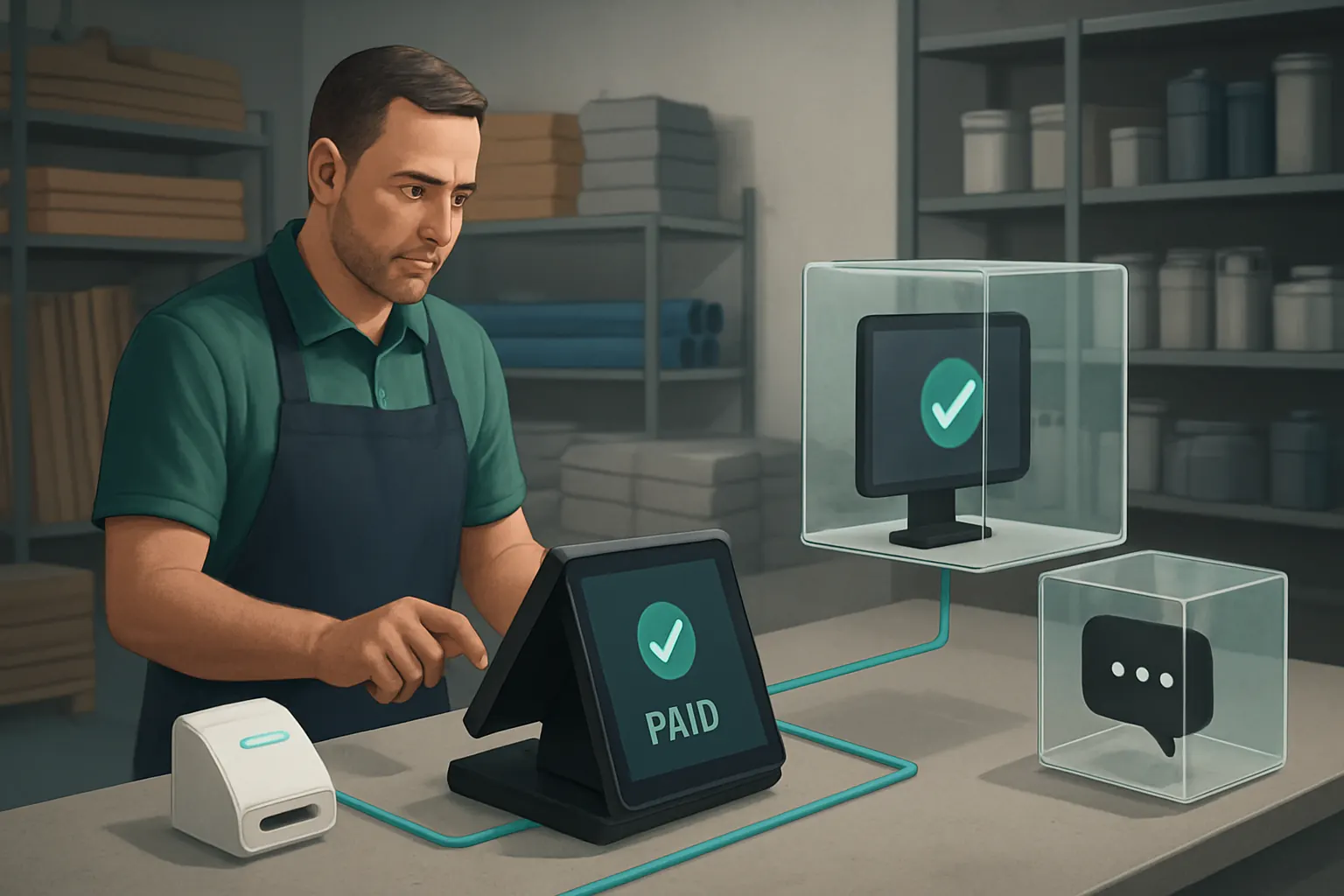
Payment status updates from card terminals update the trade account record instantly, minimising manual reconciliation work.
Controls ensuring secure data transfer and compliance
All integrations follow secure APIs and data handling consistent with PCI Security Standards and the National Cyber Security Centre recommendations.
Controlled Rollout and Staff Training to Achieve Adoption
Resistance and knowledge gaps impede automation benefits
Successful automation requires phased rollout with thorough training, clear documentation, and iterative feedback cycles.
Workflow-based change management plan
Start with a pilot branch or process, gradually extend tools with ongoing support, and monitor key metrics to adjust workflows.
Example: Training module for order exception handling
Training combines process guides, system simulations, and dedicated Q&A sessions, ensuring staff master both new technology and compliance requirements.
Controls for monitoring system use and exceptions
Regular audits review adherence to approved workflows and detect bypasses or misuse, preserving system integrity and data accuracy.

90-Day Rollout Plan for Hardware and Building-Supply Retailers
Weeks 1–2: Discovery and Integration Planning
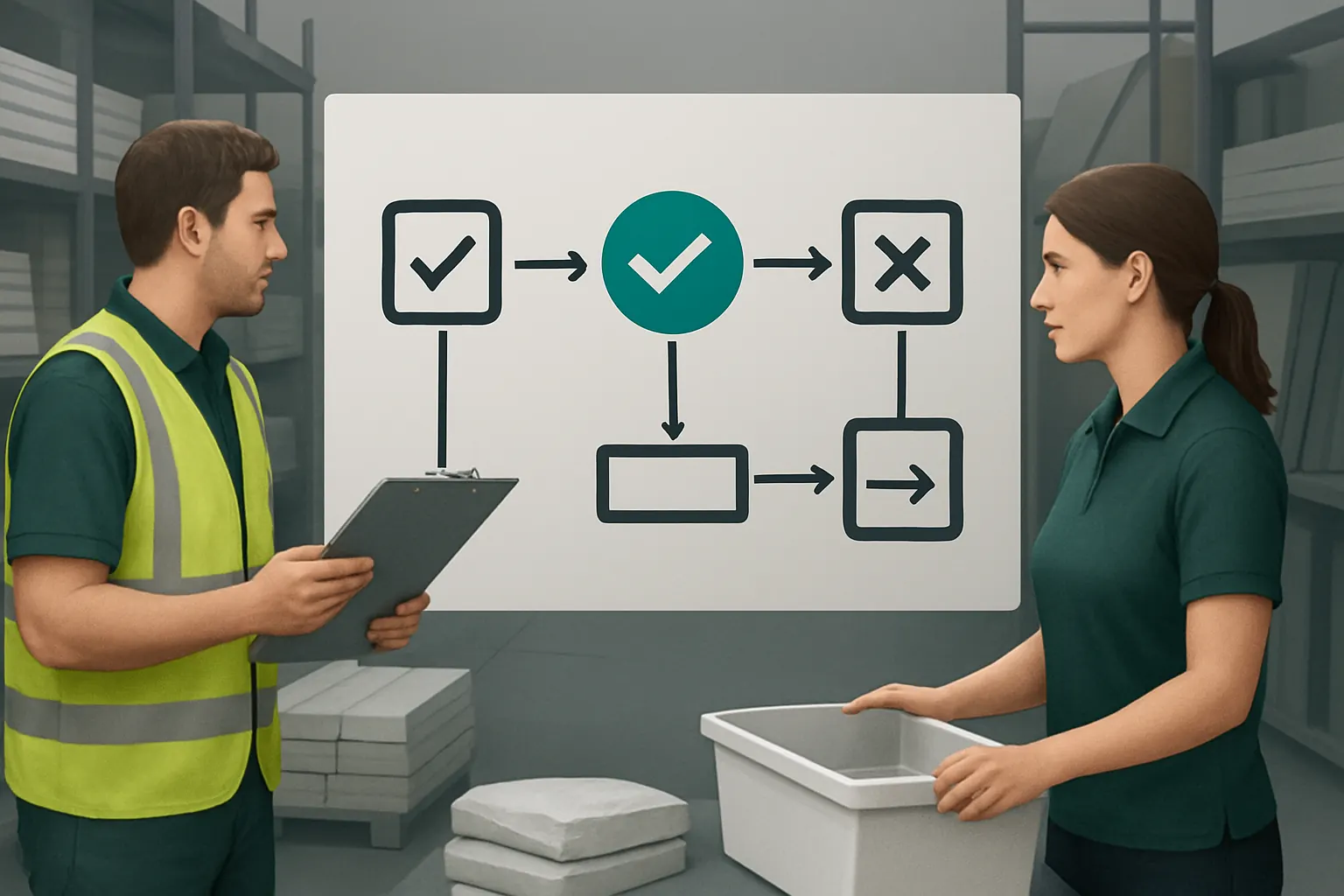
- Conduct detailed process mapping of trade accounts and order workflows.
- Assess existing systems and identify external integrations to retain.
- Define approval rules, credit terms, and exception routing logic.
- Set up initial data consolidation infrastructure.
Weeks 3–6: Build Core Connected Operating System
- Develop trade account and stock synchronisation modules.
- Establish live dashboards and reporting tools.
- Configure deterministic order validation and replenishment alerts.
- Train pilot branch staff on workflows and new tools.
Weeks 7–12: Extend AI and Automations, Scale Deployment
- Introduce AI-assisted ticket prioritisation and summarisation.
- Automate special order exception handling and returns processing.
- Roll out systems to all branches with ongoing support.
- Conduct compliance audits and training refreshers.
How AI Implementation UK Connects, Replaces, and Automates Your Operation
Our approach is straightforward and practical. AI Implementation UK designs one connected operating workspace, configured precisely around how your hardware or building-supply retail business operates. This workspace:
- Links your existing useful software—accounting systems, stock management, payment gateways—so you keep what works.
- Replaces avoidable subscriptions with modules you own, eliminating duplicated functions in unconnected SaaS silos.
- Consolidates operational data into one reliable single source across branches, trade accounts and stock records.
- Uses AI selectively to assist human decisions—classification, summarisation, prioritisation—while leaving key approvals with your managers.
- Automates routine workflows with deterministic rules, connecting them seamlessly from order receipt to stock replenishment and returns.
Through careful design and adherence to UK data protection and payment security frameworks (ICO, PCI DSS), we ensure your workflows operate smoothly, securely, and transparently.
If you are ready to move beyond fragmented software and costly manual intervention, explore our process automation services or discuss your data infrastructure needs with our team at AI strategy roadmapping. Visit our case studies to see real-world results transforming retail stock and trade account workflows.
By integrating your core processes into one owned operating system, hardware and building-supply retailers gain efficiency, control, and reliable insights—empowering sound business decisions and enhancing customer trust.