
The daily reality of running GP clinics and private healthcare practices across the UK is marked by deep rooted inefficiencies that slow down workflows, stress clinical staff, and ultimately impact patient care. From booking and managing...
What’s Breaking Daily in GP Clinics and Private Healthcare
The daily reality of running GP clinics and private healthcare practices across the UK is marked by deep-rooted inefficiencies that slow down workflows, stress clinical staff, and ultimately impact patient care. From booking and managing appointments to handling medical records, referrals and billing, many processes remain steeped in manual work. The COVID-19 pandemic exposed and amplified these vulnerabilities, creating significant backlogs, increasing pressure on clinicians, and creating bottlenecks in patient pathways.
Yet the sector hasn’t kept pace with automation and AI technology adoption, despite the availability of tools designed to reduce administrative burdens and improve data handling. Clinical staff continue to spend an excessive amount of time on paperwork, communications, and compliance tasks, which contributes not only to burnout but jeopardises accuracy and patient safety.
This article digs into five essential automations that can fundamentally transform operations in GP clinics and private healthcare, resolving key pain points and enabling a leaner, safer, and more patient-centric service model.

The Cost of Manual Work: Time, Errors, Compliance, and Cashflow
Manual workflows in healthcare are more than inconvenient; they're costly:
- Time wasted on repetitive administrative tasks drains clinical and administrative resources, slowing down patient throughput and increasing wait times.
- Data entry errors undermine patient safety, impacting diagnosis accuracy, prescriptions, and treatment plans.
- Compliance risks multiply due to inconsistent data capture and difficulty in maintaining audit trails, increasing the risk of breaches and regulatory penalties.
- Cashflow impact arises from delayed invoicing, incorrect billing, and poor claims management, especially in private healthcare settings where revenue cycles are sensitive.
- Clinician burnout due to administrative overload leads to higher staff turnover and recruitment costs.
Addressing these challenges with digital automation isn’t just about efficiency; it’s about safeguarding care quality, regulatory compliance, and financial viability.

Automating Appointment Scheduling and Patient Reminders
1) The real daily problem
GP clinics and private healthcare centres juggle multiple appointment requests across calls, websites, and walk-ins. Manual appointment booking is prone to double-booking, missed slots, and inefficient slot allocation. Patients frequently forget appointments, leading to no-shows.
2) The automation/AI approach
Automatically manage appointment scheduling by integrating calendar systems with patient portals and leveraging AI-driven chatbots for 24/7 booking. Automated reminders via SMS, email, or app notifications reduce no-shows and improve patient communication.
3) Suggested tools / system pattern
- Cloud-based scheduling platforms with API connectivity and AI-chatbots.
- SMS and email reminder systems with automated triggers.
- Systems pattern: Integrate an EHR (Electronic Health Record) system with a scheduling engine and communication middleware.
4) Implementation example
Implement a cloud scheduling system that syncs with clinicians’ calendars and allows patients to book and reschedule online. Set rules to allocate slots by appointment type and clinician availability. Configure automated reminders at 24 hours and 2 hours pre-appointment.
5) Risks/controls
- Ensure patient consent for SMS/email communications to comply with GDPR.
- Use secure messaging gateways and encrypted data transit.
- Maintain an audit trail of appointment changes and communications.
- Configure override controls for urgent booking exceptions.

Streamlining Patient Intake and Medical History Collection
1) The real daily problem
Manual patient intake forms, paper histories, and repeated questioning consume staff time and increase errors. Clinicians spend unnecessary consultation time confirming basic data, reducing time for clinical assessment.
2) The automation/AI approach
Use digital patient intake forms linked to patient portals. Employ AI-assisted data extraction from scanned documents and natural language processing (NLP) to summarise previous medical history from notes, reducing duplication.
3) Suggested tools / system pattern
- Digital forms platforms integrated with patient portals.
- Document scanning with AI-based OCR (Optical Character Recognition).
- NLP engines for extracting clinical concepts from unstructured text.
4) Implementation example
Patients complete an online intake form pre-appointment via a secure portal. Scanned past medical letters are processed with OCR and summarised by NLP into key diagnoses, medications, and allergies fields within the EHR.
5) Risks/controls
- Implement robust authentication to protect patient data.
- Confirm patients review and validate histories for accuracy.
- Ensure data processed by AI is reviewed by clinicians to avoid misinterpretations.
- Comply with NHS data governance and GDPR regulations.

Automating Clinical Documentation and Note-Taking
1) The real daily problem
Doctors and nurses spend significant portions of their day documenting patient encounters manually. This not only reduces direct patient interaction but increases the risk of transcription errors and missing important clinical details.
2) The automation/AI approach
Voice recognition combined with AI-powered clinical dictation tools can transform spoken consultations into structured clinical notes instantly, with automatic coding and data tagging.
3) Suggested tools / system pattern
- AI-driven speech-to-text dictation software trained on medical vocabulary.
- Clinical documentation systems that integrate with EHR.
- Pattern: Real-time voice transcription plus automated coding and audit logging.
4) Implementation example
Clinicians use headsets or mobile devices during consultations to dictate notes. The system transcribes the conversation into the EHR, flags key terms (e.g. diagnoses, medications), and populates structured fields automatically.
5) Risks/controls
- Maintain local data processing or use GDPR-compliant cloud services.
- Provide clinicians with editing capabilities to correct transcription errors.
- Establish access controls and audit trails to meet regulatory requirements.
- Train staff on confidentiality and system use policies.

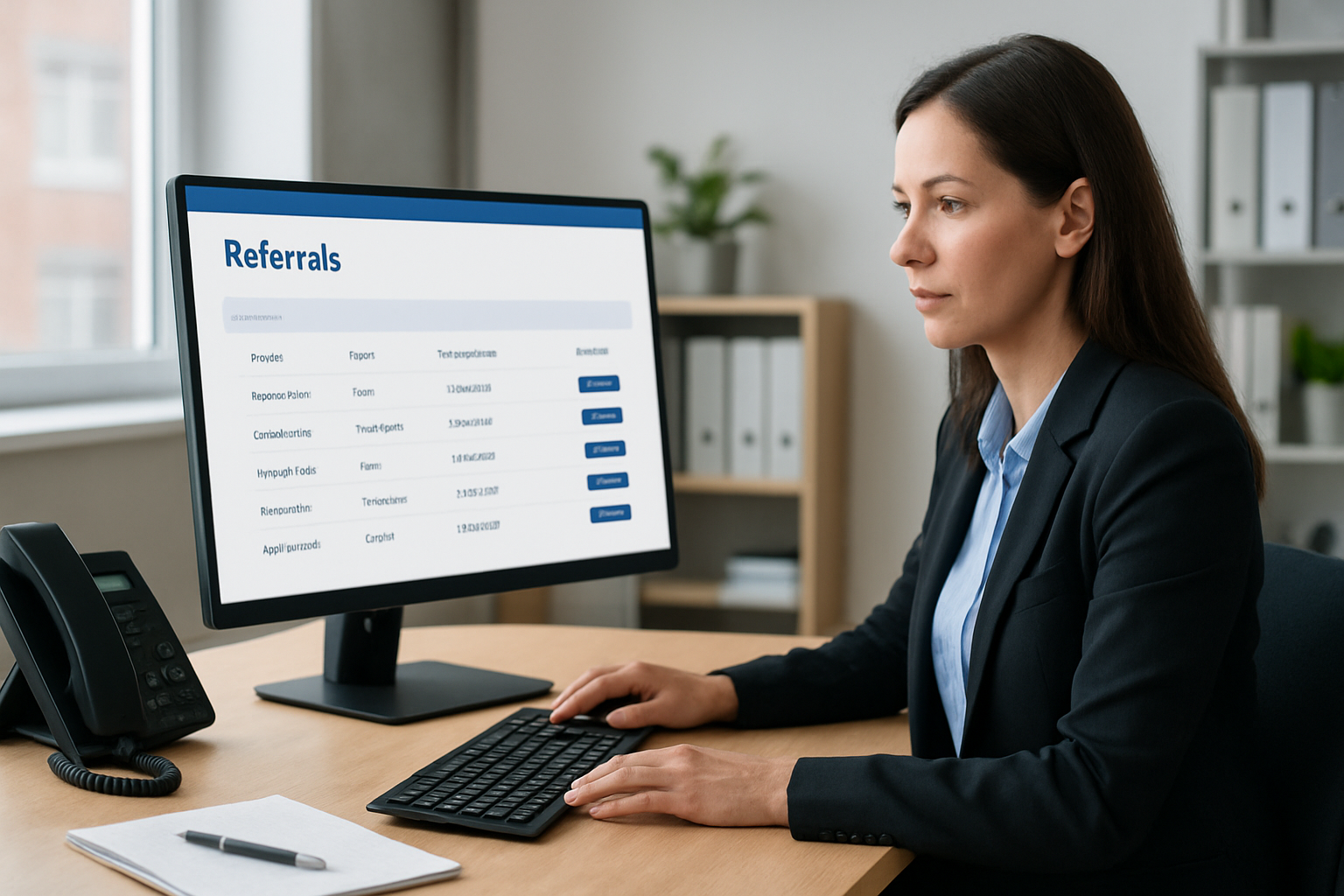
Automating Referral Management and Follow-Up Tracking
1) The real daily problem
Manual referral processing involves faxing, emails, or phone calls, often resulting in delays, misplaced requests, and poor visibility on referral status, contributing to patient dissatisfaction.
2) The automation/AI approach
A centralised, digital referral management system that tracks referrals from initiation to completion with automated alerts and integration with partner hospitals or specialists.
3) Suggested tools / system pattern
- Referral portal software with standard messaging interfaces (e.g. HL7, FHIR).
- Workflow automation tools for status tracking and follow-up reminders.
- Integration with hospital EHRs or private specialist clinics.
4) Implementation example
GPs submit referrals digitally through an integrated portal; the system routes the referral to the appropriate specialist. Automated notifications alert both patient and clinician when the referral is accepted, appointments scheduled, or reports received.
5) Risks/controls
- Secure data transit and storage to protect sensitive information.
- Build escalation and manual override options for urgent cases.
- Maintain full audit trails for referrals for medico-legal compliance.
- Obtain patient consent for data sharing as per NHS guidance.
Automating Billing and Insurance Claims Processing
1) The real daily problem
Billing and claims submission remain manual or semi-manual, resulting in delayed payments, rejected claims, and cashflow unpredictability, particularly in private healthcare where patient billing complexity is higher.
2) The automation/AI approach
Automate invoicing and claims submission to insurers with AI-powered coding validation and error detection to reduce rejections and speed up payment cycles.
3) Suggested tools / system pattern
- Billing and claims management software integrated with clinical coding (e.g. OPCS, SNOMED CT).
- AI modules for automated claim validation and fraud detection.
- Integration with accounting systems and insurer portals.
4) Implementation example
Upon consultation closure, the system auto-generates invoices based on treatment codes captured in the EHR. Claims are submitted electronically and monitored via a dashboard for payment status. Errors or rejections trigger automated alerts to billing staff.
5) Risks/controls
- Ensure patient billing data is encrypted and access is restricted.
- Monitor automated claims for discrepancies with a manual audit process.
- Keep detailed records of financial transactions for compliance.
- Train staff on GDPR and NHS billing regulations.

90-Day Rollout Plan for Automation Implementation
Weeks 1–2: Preparation and Assessment
- Map key clinic workflows identifying pain points and prioritise automations.
- Engage stakeholders including GPs, nurses, admin and IT teams.
- Evaluate existing systems for integration capability.
- Select automation tools that match operational needs and compliance standards.
Weeks 3–6: Pilot and Initial Training
- Deploy pilot versions of scheduling and patient intake automation in one or two clinics.
- Train frontline staff on new systems with hands-on sessions.
- Collect user feedback and monitor initial performance metrics.
- Refine workflows and address data governance procedures.
Weeks 7–12: Full Deployment and Monitoring
- Expand automation to clinical documentation, referral management, and billing.
- Continue user training and change management communications.
- Establish routine audits and compliance checks.
- Monitor key indicators such as appointment attendance, documentation time, referral turnaround, and billing cycle speed.
- Iterate improvements based on metrics and feedback.

Take the Next Step with AIImplementation.uk
Automating key workflows in GP clinics and private healthcare is no longer optional — it’s essential for delivering timely, safe, and cost-effective care while ensuring clinician wellbeing. At AIImplementation.uk, we specialise in guiding healthcare providers through tailored automation roadmaps that comply fully with UK regulations.
Book a free digital workflow audit with our experts today. Discover where automation can deliver the greatest impact in your practice and start your journey towards streamlined operations and enhanced patient care.
Contact AIImplementation.uk now and unlock the power of automation for your clinic.
This article brings practical, actionable insights focussed on UK healthcare businesses, helping readers understand automation benefits and how to implement effectively without compromising patient safety or regulatory compliance.