
Learn how insurance brokers can connect systems, reduce manual admin and automate client onboarding with one tailored operating platform the business owns.
What software are commonly used by insurance brokers: What Breaks Daily
Insurance brokers deal with a complex web of processes every day. From managing quote requests, onboarding new clients, to handling renewals and policy documentation, their workflows demand precision, speed, and compliance. Yet, many brokers still struggle with fragmented, manual tasks that slow down operations and introduce avoidable errors.
Common breakdowns include delayed quote turnaround times due to juggling multiple systems, manual data entry that creates inconsistencies, and cumbersome renewal management that risks missed deadlines. Fragmented data often results in poor visibility during client interactions and complicates compliance with FCA and GDPR rules.
The question most brokers ask is: what software are commonly used by insurance brokers to streamline these operations while improving accuracy and control?
Rather than adopting disparate tools that create more silos, brokers need one connected, owned operating system tailored around how they work. This allows them to keep useful existing systems in place yet integrate them seamlessly. It reduces reliance on costly subscriptions and centralises data into a reliable, single source of truth.

The True Cost of Manual Work in Broking Firms
Manual processes in insurance broking are costly:
- Time wasted chasing documents and rekeying information between siloed tools
- Increased errors and version confusion in policy and client records
- Compliance risks from overlooked deadlines and incomplete audit trails
- Cashflow impacts, with delays in onboarding, quoting, and renewals affecting commission flow
These factors combine to stifle growth, frustrate staff and clients, and leave brokers exposed to regulatory scrutiny. Automation designed specifically for the insurance broker workflow can help, but only when it suits the working patterns and integrates existing software investments.

Quote Requests Automation to Accelerate Pricing and Proposals
Practical challenges in managing quote requests
Insurance brokers often field multiple quote requests daily. These requests vary in complexity and source—from bespoke commercial lines to straightforward personal policies. Handling them manually usually involves downloading forms, extracting data, contacting insurers for rates, and tracking statuses across emails and spreadsheets. This is time-consuming and error-prone, slowing the sales cycle.
Creating a connected workflow for quotes
An owned module linked to existing client and policy records collects quote requests automatically. It extracts key data using document extraction AI tailored for insurance forms, reducing manual data entry. The module triggers workflow actions, such as escalating urgent requests to underwriters or generating standard communications to clients with progress updates.
Integrations that keep your current investment
Rather than replacing your CRM or broker management system, this module connects to them through APIs. It can also link to insurer portals selectively to automate rate retrieval and submission of quote requests where permitted. Specialist external services for secure communications or electronic signatures can remain integrated.
Example: Handling a sudden spike in quote demand
Following a regulatory change, a commercial broker receives a surge in liability quote requests. The connected quote module classifies incoming requests by line of business, prioritises urgent cases, auto-fills insurer forms, and flags complex risks requiring human review. Brokers can provide faster, accurate pricing with fewer errors.
Operational controls and compliance safeguards
Rule-based triggers enforce required reviews before quotes move forward. The system logs audit trails for all data exchanges, documenting who approved what and when. Email and document templates maintain consistency and compliance with FCA financial promotion guidelines.

Client Onboarding Automation to Streamline New Business
The onboarding bottleneck
New client onboarding typically involves multiple stages: collecting identity documents, verifying information, entering data into different systems, and providing welcome materials. Manual handoffs here create delays and degrade client experience.
A unified onboarding process tailored for brokers
An owned onboarding workspace centralises document intake, verification tasks, and form completion. AI-powered classification tools separate incoming documents by type (ID, proof of address, risk questionnaires). Workflows route exceptions, such as missing or inconsistent information, to brokers for quick resolution. Once verified, data automatically populates client records.
Integrating background checks and know your customer (KYC) steps
While core onboarding is managed internally, external vetted providers handle specialist services like electronic identity verification and AML checks. These are integrated to complement the owned system without disruption.
Example: Rapid onboarding for mid-size commercial broker clients
A client submits multiple risk and compliance documents via a digital portal. AI automatically recognises document types, extracts key data for direct input, and flags missing items. Brokers focus on exception handling, reducing onboarding time significantly and enhancing client satisfaction.
Audit trails and data privacy controls
Every step captures audit metadata to support FCA compliance and data protection obligations under ICO guidelines. Role-based access ensures confidentiality is preserved during document review and approval.

Renewal Management Automation to Minimise Risk
Renewal challenges facing brokers
Renewal deadlines often define the rhythm of insurance broking. Missed renewals risk policy lapses, client dissatisfaction, and lost revenues. Renewals frequently involve reviewing updated risk data, re-quoting, and issuing revised policies—all typically managed with calendar reminders and manual interventions.
Connecting renewals with other core records
A renewal module owns the management process within one trusted workspace. It monitors policy expiry dates and triggers alerts well ahead. By pulling data from client records and insurer communications, it bundles renewal requests into workflows that prompt brokers to confirm, update, or initiate re-quotations.
Leveraging insurer integration without disruption
Where insurers support APIs, renewal quotations and policy documents can exchange data automatically. Specialist services such as payment gateways are linked at the end to capture premiums securely.
Example: Managing multiple simultaneous renewal cycles
An insurance broker managing risks for SMEs uses automated workflows to track all active policies. The system flags those expiring in 90, 60, and 30 days, generates client notifications, and submits renewal requests to insurers three weeks ahead. Brokers only intervene on exceptions highlighted by AI summarisation of insurer responses.
Controls to uphold accuracy and FCA compliance
Automated reminder schedules reduce risk of missed deadlines, but human approval is required before renewals are finalised. Detailed audit logs document all communications and policy adjustments for regulatory inspection.

Document and Transaction Processing to Cut Admin Overheads
Manual document handling pain points
Insurance brokers process large volumes of statements of values, loss runs, and claims correspondence. These unstructured documents arrive by email or post, requiring extraction, verification, and filing—often repeated across multiple systems.
Building an owned document processing module
Intelligent document recognition extracts relevant data using AI trained on insurance-specific forms. This data synchronises with client, policy, and claims records within the broker’s owned system. Workflows route exceptions or escalations, send automated acknowledgments, and prepare data for reporting.
Seamless collaboration with specialist external tools
The core system connects to document storage and advanced OCR services as supplements, ensuring sustainable handling without multiplying subscriptions. Payments related to transactions link to PCI-compliant gateways via stable integration.
Example: Processing loss runs for annual renewals
Loss runs submitted by a client’s insurer are automatically scanned and key losses extracted. The system summarises these for brokers and highlights significant changes compared to prior years. Automated workflows send reminders to collect missing documentation and generate renewal risk reports.
Maintaining confidentiality and audit visibility
Data handling adheres to ICO guidelines, and broker access is restricted based on roles. All processing steps are logged with timestamps to maintain a comprehensive audit trail.

Reporting and Decision Support to Enhance Broker Effectiveness
Challenges from siloed data and scattered reports
Brokers often rely on multiple unconnected reports to track business metrics, compliance status, and client histories. This lacks cohesive insight and creates duplication of effort in preparing management information.
One trusted record with a tailored dashboard
By consolidating operational data within a single authorised system, brokers obtain a unified view of key performance indicators and client portfolios. Custom dashboards present real-time metrics tailored to teams—sales, compliance, underwriting—supporting quick, informed decisions.
Selective AI capabilities for insights and prioritisation
AI supports classification of cases needing urgent human attention, summarisation of complex reports, and prioritising workloads based on risk or business value. Deterministic rules drive predictable tasks, ensuring consistency.
Example: Prioritising renewal actions via AI-enhanced reports
The renewal team views a dashboard highlighting expiring policies sorted by commission value and renewal risk. AI summarises insurer comments, while rules identify policies requiring broker input. This focused insight streamlines workload management.
Controls ensuring audit readiness and human oversight
Dashboards show audit trails for data sources and interpretations. Decision support supplements but does not replace human judgements. Post-decision review workflows maintain compliance standards.

A 90-Day Rollout Plan for Automation Success
Weeks 1–2: Discovery and process mapping
- Evaluate current workflows and pain points
- Identify existing software to keep and connect
- Prioritise high-impact automation areas like quote requests and renewals
Weeks 3–6: Integration and module development
- Build owned modules tailored to broker workflows
- Link key existing systems and external services for secure payments and communications
- Configure AI models and rule engines for classification and alerts
Weeks 7–12: Testing, training, and rollout
- Pilot modules with select teams
- Provide training on new workflows and controls
- Implement audit and compliance monitoring
- Scale rollout firm-wide based on feedback
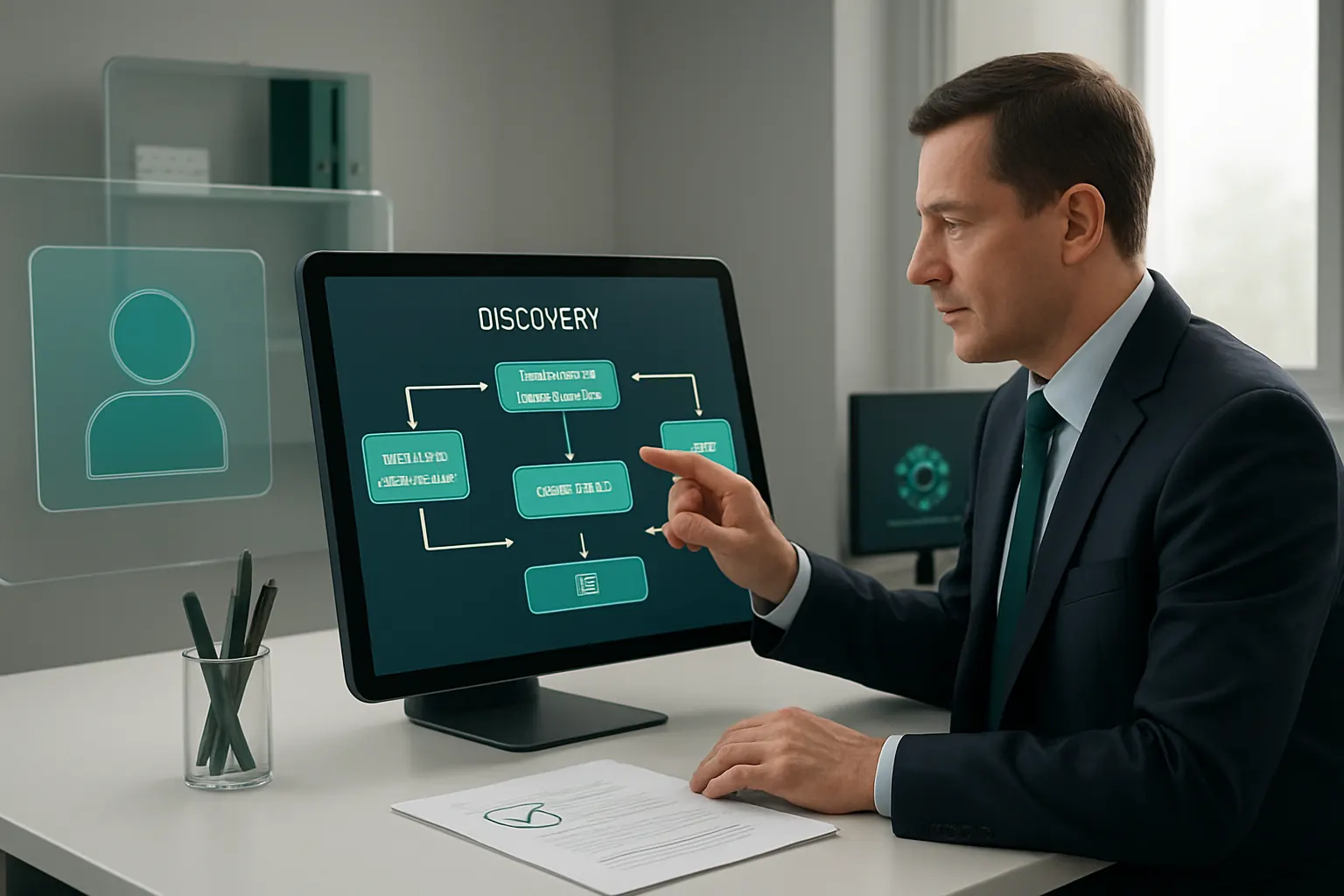
How AI Implementation UK Connects and Automates Broker Operations
Insurance brokers seeking to enhance efficiency and control need an operating system they actually own and tailor around their business. AI Implementation UK specialises in delivering connected, bespoke solutions that:
- Preserve valuable current systems, linking them through smart integrations
- Replace multiple avoidable software subscriptions with owned modules
- Centralise operational data into reliable records and customised dashboards
- Apply AI selectively to automate variable tasks like classification, summarisation, and prioritisation
- Use deterministic rules to standardise predictable processes
- Embed robust controls to support FCA compliance, client confidentiality, and authorised human reviews
By choosing to build rather than buy a one connected operating system, brokers unlock scalable automation while reducing reliance on costly, disconnected SaaS tools. AI Implementation UK’s expertise in process automation, data infrastructure preparation, and AI strategy roadmapping ensures a practical, risk-managed journey from discovery to rollout.
To see how your broking operations can transform with automation you control, explore real-world examples or begin your platform plan with us today.
For regulatory compliance guidelines related to client data and communications, visit the ICO and FCA. For secure payment handling standards, see the PCI Security Standards Council.
This approach gives insurance brokers practical ways to answer the question: what software are commonly used by insurance brokers—but with a future-proof, controlled system customised around their own business needs.