
Running a successful restaurant in the UK hospitality industry is more challenging than ever. Beyond serving quality food and delivering excellent customer service, teams struggle daily with operational inefficiencies, manual processes,...
What’s Breaking Daily in Hospitality Restaurants?
Running a successful restaurant in the UK hospitality industry is more challenging than ever. Beyond serving quality food and delivering excellent customer service, teams struggle daily with operational inefficiencies, manual processes, and costly errors. These issues quietly erode margins, frustrate staff, and limit growth potential.
This article exposes the real reasons hospitality restaurant teams fall behind in a fast-moving market and how automation can address these pain points. We provide a practical, step-by-step framework for action, including tools and risk controls, to help operators adopt automation confidently for better business outcomes.
Each day, restaurants face multiple operational stress points that create hidden losses:
- Slow order processing leads to errors and delays.
- Manual stock tracking results in waste and lost revenue.
- Inaccurate labour scheduling increases payroll costs.
- Paper-based reporting delays decisions, making managers reactive rather than proactive.
- Manual invoice matching risks missing payments or approvals.
- Payment processing delays cause cashflow issues.
- Waste tracking is unreliable, causing stock shrinkage.
- Manual compliance adds audit risks and unnecessary overhead.
Inefficiencies are not only time-consuming but also cause direct margin erosion and compliance risk. Many of these issues stem from manual, disconnected systems leaving businesses always behind the curve.

The Cost of Manual Workload: Time, Errors, Compliance, Cashflow
Manual work is costly for restaurants in several hidden ways:
- Time wasted: Hours lost daily on repetitive, non-value tasks such as stock recounts, data entry, and paperwork.
- Error risk: Human errors in orders, payroll, supplier invoices, and compliance paperwork add up financially.
- Compliance risk: Missing VAT or health and safety deadlines can lead to fines or reputational damage.
- Cashflow challenges: Slow approvals and payments delay cash inflows and complicate forecasting.
- Loss of real-time insight: Manual reporting means decisions are based on yesterday’s data, not today’s needs.
- Labour inefficiency: Misaligned staff scheduling increases overtime and underutilises talent.
- Revenue leakage: Mistaken pricing, lost orders, and waste mean lost sales and profits.
By automating key processes, restaurants can reduce these costs, reclaim staff time, improve accuracy, and free managers to focus on customers.

8 Reasons Hospitality Restaurant Teams Fall Behind (And How Automation Fixes It)

Inefficient Manual Order Entry
Problem:
Order entry mistakes are common in busy environments—servers mishear guests or cashiers mistype orders, resulting in errors, wasted food, and unhappy customers.
Automation Approach:
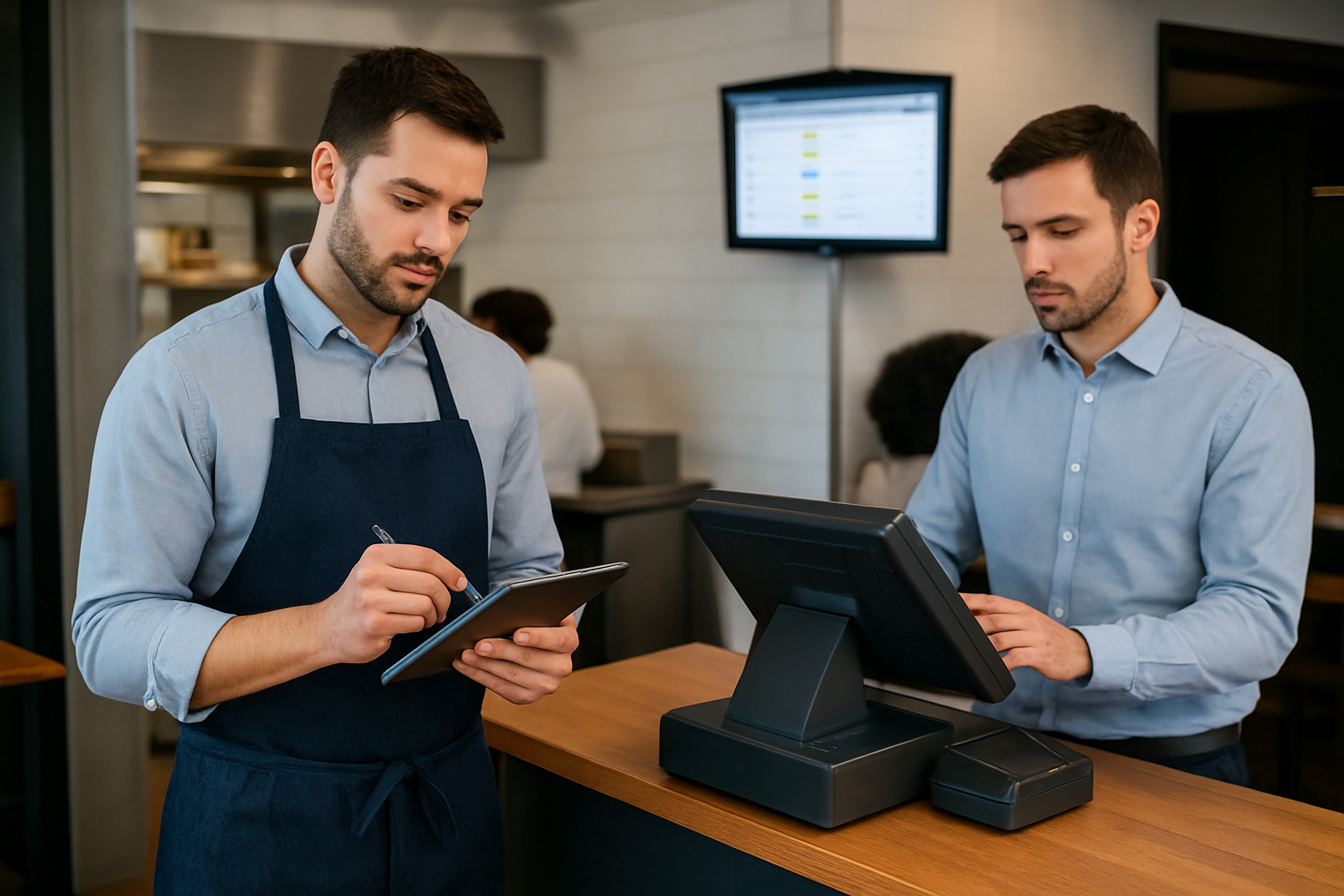
Implement digital POS systems integrated with kitchen display screens and order management software.
Suggested Tools/Pattern:
POS terminals (e.g., Square, Lightspeed), kitchen display systems, integrated order management platforms.
Example:
Switch from handwritten or verbal orders to tablets that sync instantly to the kitchen, reducing order errors by up to 30%.
Risks/Controls:
- Ensure encryption for payment data.
- Restrict user access to POS features.
- Maintain audit logs of orders for dispute resolution.
Slow and Inaccurate Inventory Tracking
Problem:
Manual stock counts, usually done weekly, are prone to errors and delays, leading to overstocking or shortages and increased food waste.
Automation Approach:
Deploy inventory management software with barcode or RFID scanning to track stock levels in real time.
Suggested Tools/Pattern:
Inventory platforms like MarketMan or in-house customised systems integrated with POS and suppliers.
Example:
Staff use handheld scanners to log deliveries, automatically updating stock levels and triggering reorder alerts.
Risks/Controls:
- Regularly calibrate scanners for accuracy.
- Implement access controls to inventory data.
- Keep supplier delivery records for cross-verification.

Manual Labour Scheduling and Payroll Errors
Problem:
Paper rosters or spreadsheets cause overstaffing or understaffing, increasing labour costs and lowering team morale due to shift mismanagement.
Automation Approach:
Use workforce management systems that automate schedule optimisation and payroll integration.
Suggested Tools/Pattern:
Scheduling tools like Deputy, RotaCloud linked to payroll systems such as ADP or Sage.
Example:
Managers create schedules based on sales forecasts; employees receive shift notifications via app, with timesheets feeding directly into payroll.
Risks/Controls:
- Protect personal staff data with robust access controls.
- Maintain audit trails for shift changes and approvals.
- Ensure GDPR compliance for employee information.

Manual Invoice Processing and Payment Approvals
Problem:
Manual matching of supplier invoices and purchase orders is time-consuming, prone to missed or duplicated payments, and risks cashflow disruptions.
Automation Approach:
Implement accounts payable automation to scan, match, and approve invoices electronically.
Suggested Tools/Pattern:
Invoice processing platforms like Tipalti or Stampli with workflow routing for approvals.
Example:
Invoices are scanned and automatically matched to orders; managers approve online, and payments are scheduled automatically.
Risks/Controls:
- Enforce dual approval workflows to prevent fraud.
- Limit invoice processing to authorised personnel.
- Keep detailed logs for audits.

Paper-Based Compliance and Reporting
Problem:
Manual reporting for health & safety, VAT returns, or waste tracking leads to delays and incomplete records, increasing the risk of penalties.
Automation Approach:
Automate compliance reporting with tailored workflows and digital checklists.
Suggested Tools/Pattern:
Compliance platforms customised for hospitality, e.g., SmartCompliance or in-house digital forms integrated with cloud storage.
Example:
Daily digital checklists completed by staff trigger automatic reminders and generate compliance reports accessible to management and auditors.
Risks/Controls:
- Secure data storage with encrypted backups.
- Maintain electronic signature records for accountability.
- Regularly update compliance rules in software.

Unreliable Waste Tracking
Problem:
Waste is recorded manually on paper or spreadsheets, often inconsistently—this hides true costs and wastes money.
Automation Approach:
Use waste tracking software that records waste in real-time and links to inventory for analysis.
Suggested Tools/Pattern:
Waste management apps like Leanpath or integrated POS modules.
Example:
Staff log waste via tablet app at shift end; managers review trends to identify cost-saving opportunities.
Risks/Controls:
- Validate entries periodically with spot checks.
- Restrict editing rights and require sign-off.
- Use data anonymisation when sharing reports externally.

Disconnected Systems and Data Silos
Problem:
Different manual or legacy systems for orders, inventory, payroll and reporting rarely “talk” to each other, limiting insight and creating duplicated work.
Automation Approach:
Move to integrated software ecosystems or use APIs to enable data sharing and automation between systems.
Suggested Tools/Pattern:
Cloud-based hospitality ERP platforms or middleware connectors like Zapier.
Example:
Connected systems automatically update inventory when sales are recorded, and payroll adjusts based on shift reports, eliminating double data entry.
Risks/Controls:
- Perform data validation on synced records.
- Use encrypted APIs with strict authentication.
- Regularly audit system integrations for accuracy.

Manual Customer Feedback and Reservation Management
Problem:
Paper reservation books and feedback forms limit ability to respond quickly or analyse trends, reducing customer satisfaction and repeat visits.
Automation Approach:
Deploy online reservation platforms and digital customer feedback tools with analytics.
Suggested Tools/Pattern:
Reservation systems like OpenTable paired with survey tools such as Typeform or Medallia.
Example:
Customers book via website or app; automated follow-up emails gather feedback, which managers review monthly.
Risks/Controls:
- Comply with data privacy laws on customer information.
- Enable opt-in consent for marketing follow-ups.
- Protect feedback data with secure cloud storage.

A 90-Day Rollout Plan for Automation Adoption
Weeks 1–2: Assessment and Prioritisation
- Conduct a thorough audit of current manual processes.
- Identify high-impact pain points (e.g., order entry, inventory).
- Engage key staff and set clear automation goals.
- Select initial tools or vendors for pilot testing.
Weeks 3–6: Pilot and Training
- Implement automation in a controlled environment or single site.
- Provide hands-on training for users.
- Monitor performance and gather user feedback.
- Adjust workflows and permissions as required.
Weeks 7–12: Full Implementation and Optimisation
- Roll out automated systems across all locations or teams.
- Integrate systems for seamless data flow.
- Continuously track KPIs (labour efficiency, waste reduction, error rates).
- Refine processes and embed best practices.

Call to Action: Let AIImplementation.uk Help You Modernise Your Restaurant
Manual processes are crippling margins and productivity across today’s hospitality sector. However, the right automation roadmap can transform restaurant operations, reduce costs, and empower teams.
At AIImplementation.uk, we specialise in guiding UK hospitality businesses through practical, risk-managed AI and automation adoption. Book a complimentary operational audit with us today—it’s your first step towards unlocking efficiency, accuracy, and better business decisions.
Contact us now to book your free audit and start your journey to automation success.