
General building contractors face persistent operational challenges that interrupt workflows and reduce competitiveness. Labour shortages, volatile material costs, tight cash flows, delayed payments, shifting regulations, and site safety...
What’s Breaking Daily in General Building Contractors
General building contractors face persistent operational challenges that interrupt workflows and reduce competitiveness. Labour shortages, volatile material costs, tight cash flows, delayed payments, shifting regulations, and site safety demands combine to create daily breakdowns. These issues often manifest as missed deadlines, inaccurate estimates, slow approvals, and fractured communication between subcontractors, suppliers, and clients.
Behind the scenes, fragmented software systems and manual processes cause data duplication, errors, and loss of visibility. Teams often juggle multiple disconnected tools—each with subscriptions and overlapping features—which amplifies complexity without solving root problems. Without better integration, critical information waits in inboxes or spreadsheets rather than energising decisions on site progress, certification or payments.
This article reveals eight major reasons general building contractors fall behind and explains, in practical terms, how intelligent automation embedded in one owned operating platform can fix them—connecting and reducing redundant software and using selective AI capabilities to enhance productivity while retaining human control.

The Cost of Manual Work
Manual work in building contracting eats capacity and introduces error and risk.
- Time wasted transferring information between systems or chasing subcontractors.
- Errors and discrepancies in estimates, schedules and site evidence, leading to delays and rework.
- Compliance failures with evolving safety, competency, and regulatory standards.
- Cash flow impacts from slow invoicing, payment delays and poor forecasting.
- Communication breakdowns causing confusion in operational handoffs.
Manual processes stall reactivity, reduce accuracy, and increase compliance and financial exposure. An owned platform approach with connected modules driven by deterministic business rules, augmented by AI where appropriate, solves these issues and improves the entire operational picture.

Tender and Estimate Chaos
The real daily problem
Compiling tenders and cost estimates is cumbersome. Teams hunt for subcontractor quotes, material prices fluctuate unpredictably, and spreadsheets frequently become outdated. This slows bids and reduces competitiveness. Plus, fixed-price contracts and payment delays magnify financial risk.
The automation/AI approach
Automate enquiry tracking, subcontractor quote follow-up, and estimate consolidation. AI-driven classification highlights urgent tenders or price spikes. Deterministic rules flag outdated prices or missing approvals. Human reviewers retain final approval to ensure accuracy.
Owned platform pattern and useful integrations
- Centralised tender and estimate module replacing multiple spreadsheets and email threads.
- Integration with existing procurement systems to pull in verified supplier info.
- Use payment platforms like GoCardless or Stripe to prepare linked payment schedules.
A simple implementation example
When a new tender request arrives, the system sends automated reminders to subcontractors for quotes, imports latest material costs, highlights estimates falling outside risk limits and reports to the manager for sign-off—all from one platform dashboard.
Risks and controls (data privacy, approval, audit trail)
Tender data is confidential; access controls and audit trails monitor who views and edits. Final submission requires human sign-off, and the platform logs all changes to provide full traceability and compliance under Construction Act guidelines.

Subcontractor Scheduling Delays
The real daily problem
Subcontractor availability changes often go unnoticed until the last minute, causing site delays and rescheduling costs. Manual phone and message chasing create fragmented communication.
The automation/AI approach
Automated dispatch triggers and prioritised follow-up messages optimise subcontractor scheduling. AI classification identifies urgent or delayed jobs requiring human intervention. Deterministic rules update schedules based on subcontractor confirmations or cancellations.
Owned platform pattern and useful integrations
- Scheduling and dispatch module integrated with messaging platforms such as Microsoft Teams or Slack.
- Calendar sync with subcontractor availability data to maintain accurate job packs.
A simple implementation example
The platform automatically assigns jobs based on subcontractor availability data, follows up delayed confirmations via SMS, and escalates unresolved issues to site managers for immediate action.
Risks and controls (data privacy, approval, audit trail)
Subcontractor contact data is protected under GDPR with role-based permissions controlling who sends messages. Dispatch records are logged for accountability and safety audits.

Site Progress Tracking Breakdowns
The real daily problem
Accurate progress reporting often depends on manual input and paper records. Disparate systems mean evidence and certification get lost or delayed, risking compliance and contract disputes.
The automation/AI approach
Use tailored input forms and mobile site apps linked directly to the platform to collect live site progress, photos, competency checks, and certificates. AI summarisation tools prioritise abnormal or critical reports for review.
Owned platform pattern and useful integrations
- Digital job packs, competency record storage, and certificate management in one central module.
- Integration with site safety apps for real-time safety incident recording.
- Document storage includes automatic version control.
A simple implementation example
A site engineer uses a tablet to update progress, attach photos, and record safety checks. The platform automatically compiles certificates into client-ready reports. AI highlights incomplete or flagged reports for follow-up.
Risks and controls (data privacy, approval, audit trail)
Site data includes personal information in competency records; GDPR compliance applies. Approval workflows ensure no certificates are issued without verified review. All inputs and changes are fully audit-trailed.

Inaccurate and Delayed Job Packing
The real daily problem
Preparing and distributing job packs and compliance certificates is slow and error-prone when done manually, leading to confusion and delays downstream.
The automation/AI approach
Automate generation of standard job packs and certificates pulling live operational data. AI assists by classifying exceptions or unusual job details requiring human review.
Owned platform pattern and useful integrations
- Template-driven job pack and certificate generation embedded in the platform.
- Export and integration options for client portals and official records.
A simple implementation example
Once a job reaches a particular status, the platform auto-populates job pack fields and generates PDF certificates for client and subcontractor distribution. Alerts prompt senior review of any flagged items.
Risks and controls (data privacy, approval, audit trail)
Job packs often contain sensitive client and subcontractor data; platform restricts external access appropriately. Digital signatures or manual approval steps ensure compliance and accountability.

Labour Shortages and Resource Allocation
The real daily problem
High-skilled labour shortages create inefficiencies in job allocation and subcontractor engagement, often doubling back to lost revenue.
The automation/AI approach
Use AI to prioritise dispatch based on urgency, job complexity and subcontractor skills, combined with deterministic rules for site safety and competency requirements.
Owned platform pattern and useful integrations
- Skills and competency records managed centrally for resource allocation.
- Notifications tied into subcontractor scheduling and marketplace platforms.
A simple implementation example
Labs or subcontractors input availability and qualifications; the system dynamically suggests ideal shortlists for dispatch, ensuring regulatory safety compliance.
Risks and controls (data privacy, approval, audit trail)
Sensitive competency data protected under GDPR. Automation outputs audited regularly to prevent bias. Managers maintain approval rights on allocations for critical sites.

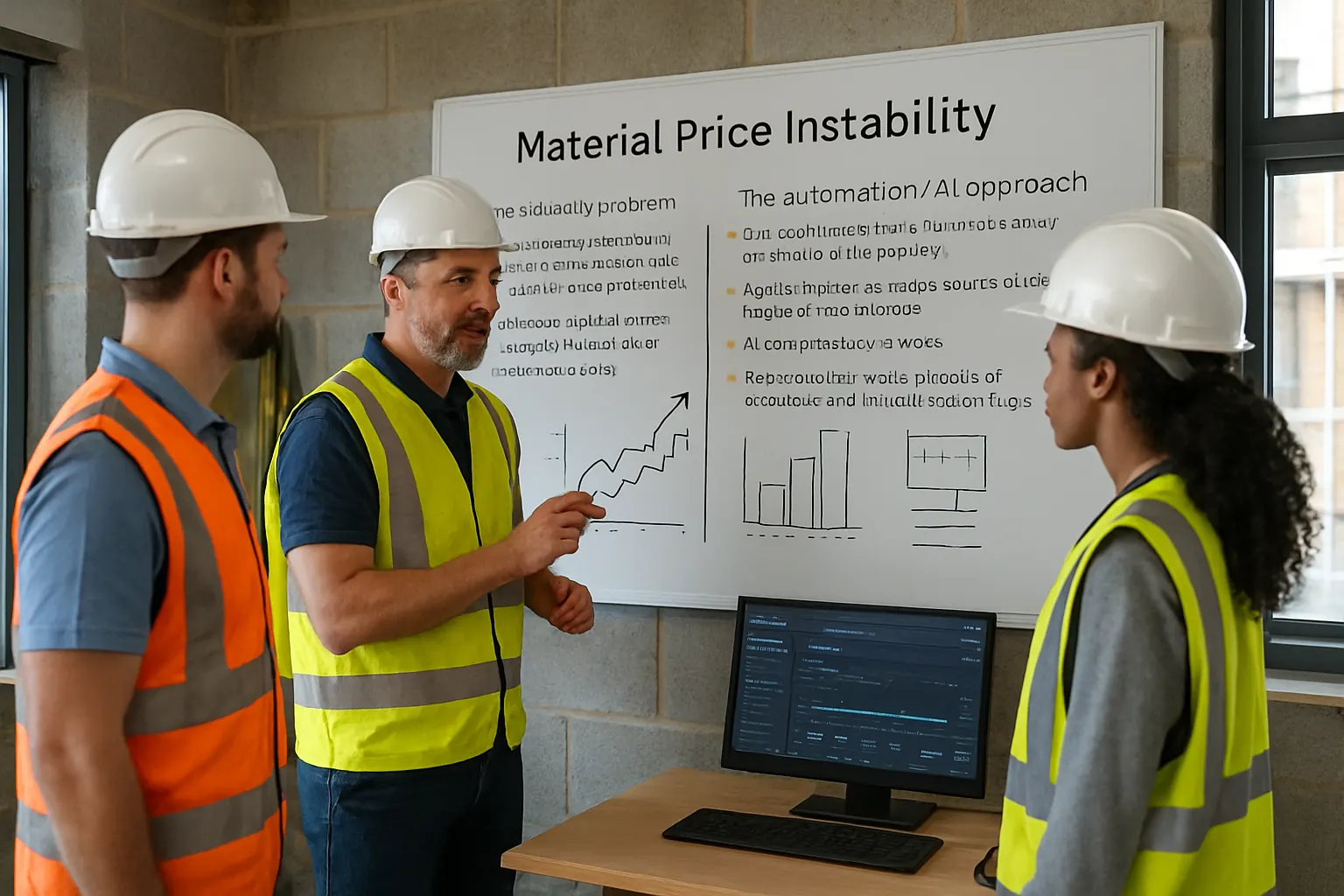
Material Price Instability
The real daily problem
Fluctuating material prices impact estimates, cashflow, and profitability. Manual updates mean teams often work on stale cost data.
The automation/AI approach
Integrate real-time updates from verified suppliers on pricing. Alert triggers activate when costs deviate beyond thresholds. AI helps summarise trends. Deterministic rules adjust contracts and budgets accordingly.
Owned platform pattern and useful integrations
- Pricing dashboard connects to supplier databases or APIs.
- Budgeting and contract management modules under one roof.
A simple implementation example
The system imports updated material prices daily, flags costing overruns in tenders or pending jobs, and prompts procurement or finance leads to review. Contract variations can be prepared automatically.
Risks and controls (data privacy, approval, audit trail)
Supplier data kept confidential; pricing updates are logged for audit. Cost escalation approvals involve multi-step sign-offs to reduce financial risk.
Cashflow and Payment Delays
The real daily problem
Payments commonly lag by 60-90 days, constraining cashflow and increasing insolvency risk. Manual invoicing and reconciliation extend delays.
The automation/AI approach
Automate invoice generation, client approvals and payment reminders. AI prioritises overdue payments and assists with forecast cashflow models.
Owned platform pattern and useful integrations
- Accounts receivable module with automated invoice and reminder workflows.
- Integration with payment platforms like GoCardless, Stripe or banking APIs to reconcile receipts.
A simple implementation example
Upon certificate sign-off, an invoice is generated and sent automatically. Payment reminders escalate based on customised schedules. Finance teams monitor cashflow dashboard updated in near real-time.
Risks and controls (data privacy, approval, audit trail)
Financial data is encrypted and access-controlled. Invoice changes require managerial approval. Full history of invoices and payments maintained for audit.

Compliance and Safety Risk Management
The real daily problem
Constantly evolving regulations under the Building Safety Act and site safety requirements impose heavy compliance burdens. Incomplete records lead to penalties and reputational damage.
The automation/AI approach
Automate safety audits, competency verifications, and regulatory reporting. AI assists by classifying risk areas and summarising compliance gaps. Deterministic rules enforce milestone approvals.
Owned platform pattern and useful integrations
- Compliance and safety module integrated with HR and site reporting.
- Notifications and escalation workflows for overdue checks.
A simple implementation example
Before site starts, the platform confirms all competency certificates and safety checks are current. Automatic alerts trigger if any are missed. Compliance reports compile audit-ready evidence with one click.
Risks and controls (data privacy, approval, audit trail)
Personal data subject to GDPR, with permissions tightly controlled. Safety approvals require human authorisation. All compliance activities logged and available for inspections.

A 90-Day Rollout Plan for Automation Success
Weeks 1–2: Discover and Prioritise
- Conduct operational audit focusing on key pain points: tendering, scheduling, certification, cashflow.
- Map current systems and workflows; identify which modules and integrations are needed.
- Define short-term automation goals aligned with business priorities.
Weeks 3–6: Build and Integrate
- Configure and customise owned platform modules around workflows.
- Connect existing software (procurement, communication, payments) to the platform.
- Develop automated workflows and rule sets, integrating selective AI capabilities.
Weeks 7–12: Test, Train, and Launch
- Pilot automation on specific teams or projects; collect user feedback.
- Train users on new workflows and platform functions.
- Refine rules, AI models, and approval pathways.
- Roll out organisation-wide with ongoing monitoring and support.

How AI Implementation UK Helps Connect, Replace, and Automate Your Operation
At AI Implementation UK, we specialise in delivering one connected operating platform tailored around the way your building contracting business works—one that you fully own and control.
Our approach is deliberate: we do not replace your existing valuable systems unnecessarily but connect them securely under one roof. This eliminates the costly duplication of software subscriptions and creates a single, reliable record of all operational data. From tendering and estimating to subcontractor scheduling, site progress, compliance, and cashflow, every process is modelled in an integrated platform designed around your daily workflows.
We apply AI as a carefully selected capability—classifying documents, summarising site reports, prioritising jobs, or supporting key decisions—never replacing human judgement on critical matters like safety approvals or contract sign-off. Meanwhile, deterministic business rules automate predictable tasks reliably and transparently.
Our platform supports integration with trusted external services where they provide specialist functions likely to remain stable, such as payment gateways (GoCardless, Stripe) or communication connectors (Microsoft Teams, SMS gateways). You retain ownership of your data and full control over workflows, with built-in audit trails and compliance features tuned for current and upcoming UK construction regulations.
Implementing our approach means overcoming the chronic inefficiencies, risks, and frustrations that hold back general building contractors today—delivering real operational clarity, financial control and regulatory confidence. Together, we equip your teams with the right technology foundation to work smarter, not harder, and respond swiftly to market changes.
With our proven 90-day rollout plan, you can gain tangible benefits rapidly—freeing your people from manual bottlenecks to focus on high-value work that grows your business sustainably.
By addressing these eight key problems with connected automation and selective AI, general building contractors gain the operational resilience and efficiency needed to compete in 2026 and beyond. The choice is clear: consolidate, connect, automate—and stay ahead.